A tenant calls, a ceiling tile is stained, and the manager has four more buildings to check before lunch. The first action is not a roofer search. It is a decision about whether the leak is a single detail or a roof-wide condition, because the answer sets the budget request that goes to the owner. Everything after that call depends on how quickly someone can tell the two apart.

Property managers in and around Lowell, MA, hold a mixed set of roofs: mill buildings near downtown, suburban office parks off Route 3, flex buildings along industrial corridors and strip centers on arterial roads. Each building has its own roof age, its own warranty status and its own tenant tolerance for disruption. The roofing plan has to respect all of that and still give the manager a number to defend.
A portfolio with many roof types
The historic district downtown reaches commercial blocks, mill yards and canal edges, so managers there are often caring for legacy mill buildings whose exterior work is subject to Historic Board review. Billerica lists commercial property from small storefronts to large industrial space, and its Concord Road area holds multiple large office buildings. Forest Ridge Business Park is described as a three-building office setting off Route 3.
A manager holding properties across those settings is really holding several different roofing problems at once. A mill roof with parapets and old flashing behaves differently from a single-ply membrane on an office building, and a storefront roof with a rooftop unit behaves differently from both. The condition report uses the same format for each, so the manager compares like with like even when the buildings do not resemble one another.
Roof type, age, remaining service life and visible defects go in one table. That table becomes the document the owner reads when a budget is requested. A manager who also looks after medical office space can pair it with the approach used for health systems, where the room below sets the priority.
Handling the tenant leak call
The report arrives through a tenant, often with limited information: a stain, a drip, a smell. The first-hour check confirms where the water is entering, whether the area below can be protected and whether anyone is at risk from wet ceilings or electrical equipment. The manager receives a short written update the same day, with what was found, what was done to stop the water and what happens next.
A clear record protects the manager when disputes arise. If a tenant claims damaged inventory, the log shows when the report came in, what interim protection was placed and when the first inspection happened. It also separates emergency work from the permanent repair, so the invoice makes sense to the owner who did not see the leak.
For leaks that need an immediate response, the emergency roof repair sequence runs at any hour, and the manager's contact information goes on the job file so updates reach the right person.
Maintenance cycles that fit a budget year
Regular precipitation runs through the Lowell year, with the NOAA station normals totaling 48.51 inches annually, and winter storms including nor'easters and ice storms appear on the city's hazard record. A roof that is cleaned and checked twice a year, typically before winter and after it, loses less to clogged drains and lifted flashing than one visited only after a leak.
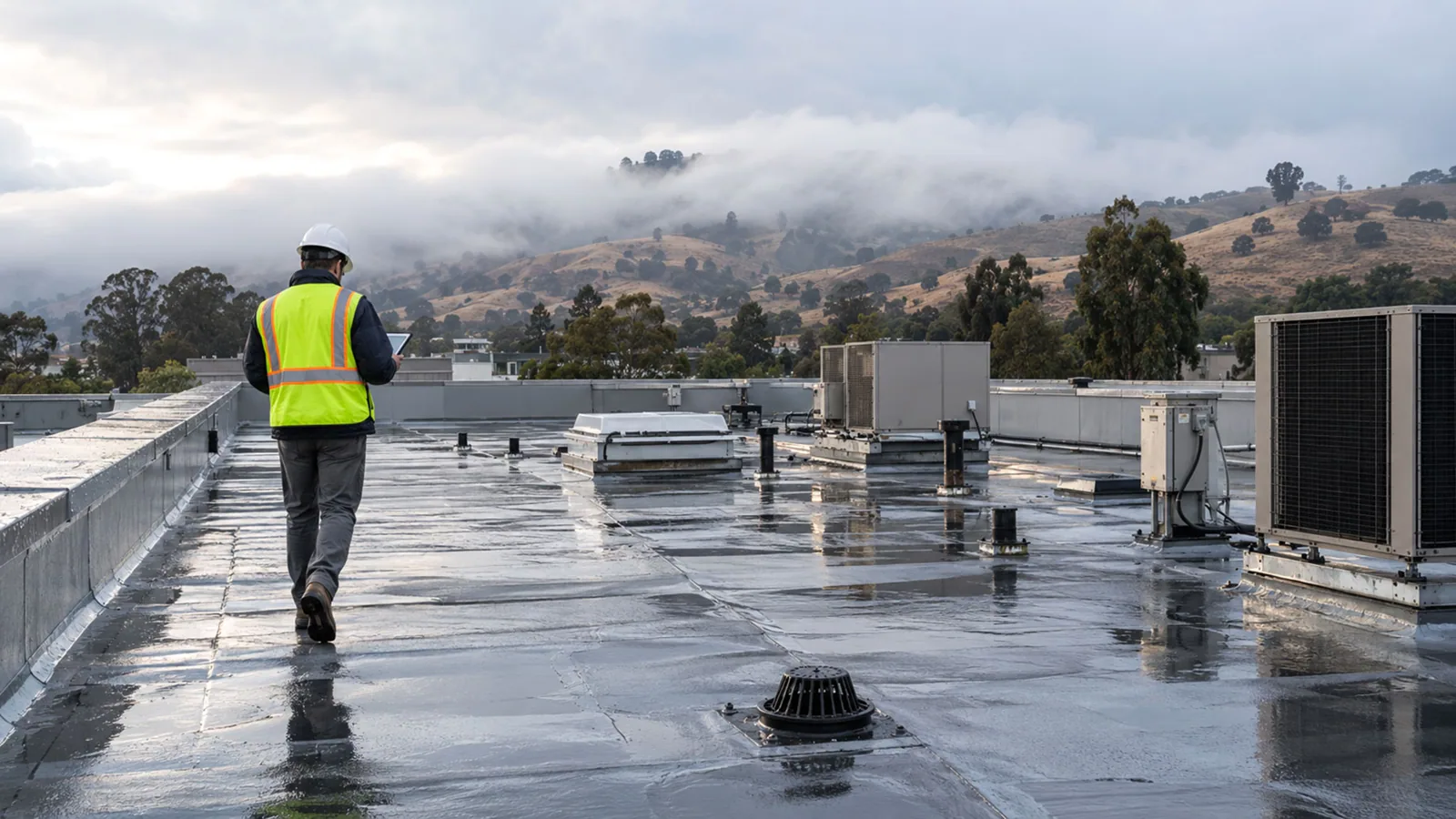
A preventive maintenance program gives the manager a calendar and a line item. Visits clear drains and scuppers, inspect seams and flashing, check rooftop equipment curbs, and photograph every change since the last visit. Small repairs happen on the spot, and larger ones are written into a proposal with a price.
That calendar also feeds the annual budget. A manager who knows which roofs will need attention in the next twelve months can ask for the money in the right quarter, rather than explaining an emergency to an owner in January.
Reporting that an owner will read
Owners ask three questions: what is wrong, what does it cost and what happens if we wait. A useful roof report answers all three on the first page. The finding is stated plainly, the repair boundary is marked, the cost is split into roof work, access, interior protection and weather risk, and the delay scenario is described in terms of what the water will reach next.
Photographs go in the report, along with a roof plan showing the location of every finding. Where a warranty is active, the report notes which repairs are allowed under its terms and what notice must be given. This saves the manager from guessing, and it keeps the warranty file in order for a future sale or refinancing.
Managers who report to institutional owners can pair the roof report with a capital plan, which shows the replacement horizon for each building and the reserve needed to cover it.
Coordinating several properties at once
Managing five buildings is easier when the inspection schedule is shared. Visits are grouped by area so that one crew can survey a cluster of buildings in a day, which reduces travel and keeps the findings fresh. Chelmsford, with its Route 3 and 129 technology corridor of large offices and corporate headquarters, and nearby Westford with its office parks, are two places where a manager may hold more than one office building. A cluster of office buildings in Chelmsford can be surveyed in one day.
The same grouping works for repair and replacement. When two buildings need work in the same quarter, mobilization and equipment costs spread across both. A multi-site roof program sets an order of work, a reserve estimate and a repair queue for the full set of properties.
For owners who also invest in buildings, the same data supports acquisition and hold decisions, since a roof history is part of what a buyer asks to see.
Commercial Roofing Questions
How can a manager tell a one-spot leak from a failing roof?
Count the locations and check the moisture. A single stain with dry insulation around it points to one failed detail. Several stains, wet insulation in more than one section or repeated seam lifts point to a roof-wide condition. An infrared survey settles the question before a repair budget is requested.
Who pays when a tenant's inventory is damaged by a roof leak?
That is set by the lease and the owner's insurance, not by the roofer. What we provide is the record: when the report came in, what protection was placed, what the inspection found. A clear log makes that conversation shorter.
Can roof work be scheduled to avoid retail hours or office peaks?
Yes. Noisy tear-off and lift movements are planned for hours when the building is quiet, and the scope lists those hours with their cost. A reroof on an occupied building opens one section at a time so the rest of the roof stays tight.
What is the cheapest way to extend the life of an aging roof?
Keep water off it and fix details early. Clear drains, replace failed sealant, secure loose flashing and patch punctures before water reaches the insulation. If the membrane is still sound, a coating restoration can add years without a tear-off.
How does a manager document roof history for a future sale?
Condition reports, repair records, photographs and warranty paperwork go in one file per building. When a buyer's survey arrives, the manager has the history ready, and the roof's age and repair record are stated with evidence rather than memory.