Permit timing sets the calendar for most replacement decisions in Tewksbury, MA, and the leak report sets everything before it. The town has direct access to I-93 and I-495, it lists Route 38 and Woburn Street corridor studies as current planning resources for local business areas, and its Community Development office offers site-selection, permitting and licensing guidance to businesses. For a roof owner, those three facts translate into logistics: trucks can reach a site, the corridors are under planning attention, and approvals have a known place to start.
Work covers repair, recovery, coating, replacement and inspection of flat and metal roofs, with a crew available at any hour. The order of work holds on every site: access, interior cover, dry-in, then boundary.
Permit Timing and Weather Windows
A temporary dry-in needs no wait. A replacement does. The scope goes to the building department with the roof section data, the insulation and fastening plan and the code references, and the review time is added to the schedule. If the review lands in a cold, wet stretch, the permanent work waits for a return window, and the temporary measures stay in place. The cost update lists the price of that holding period.
Tenth-edition rules, drawn from the 2021 IBC, govern filings from July 1, 2025 onward, and whether Tewksbury has tightened the energy provisions decides how much insulation the scope carries. The town's Community Development staff are a starting point for questions about permitting. We confirm the answer and write it into the scope before material is ordered.
Return windows matter here: at the Lowell station January runs near 25 degrees and a year brings 48.51 inches.
The same record notes any prior permits on file for the roof, so the next review starts from known history.
First-Hour Steps
The first call collects four items: where water is entering, what sits below it, who holds the roof keys and whether the surface can be reached safely. Ice, wind and wet metal edges can all close a roof for a while, and a crew that cannot go up works from the inside first. Interior protection comes before the roof repair: tarps over equipment and stock, drip containment, a shut-off recommendation if electrical equipment is exposed.
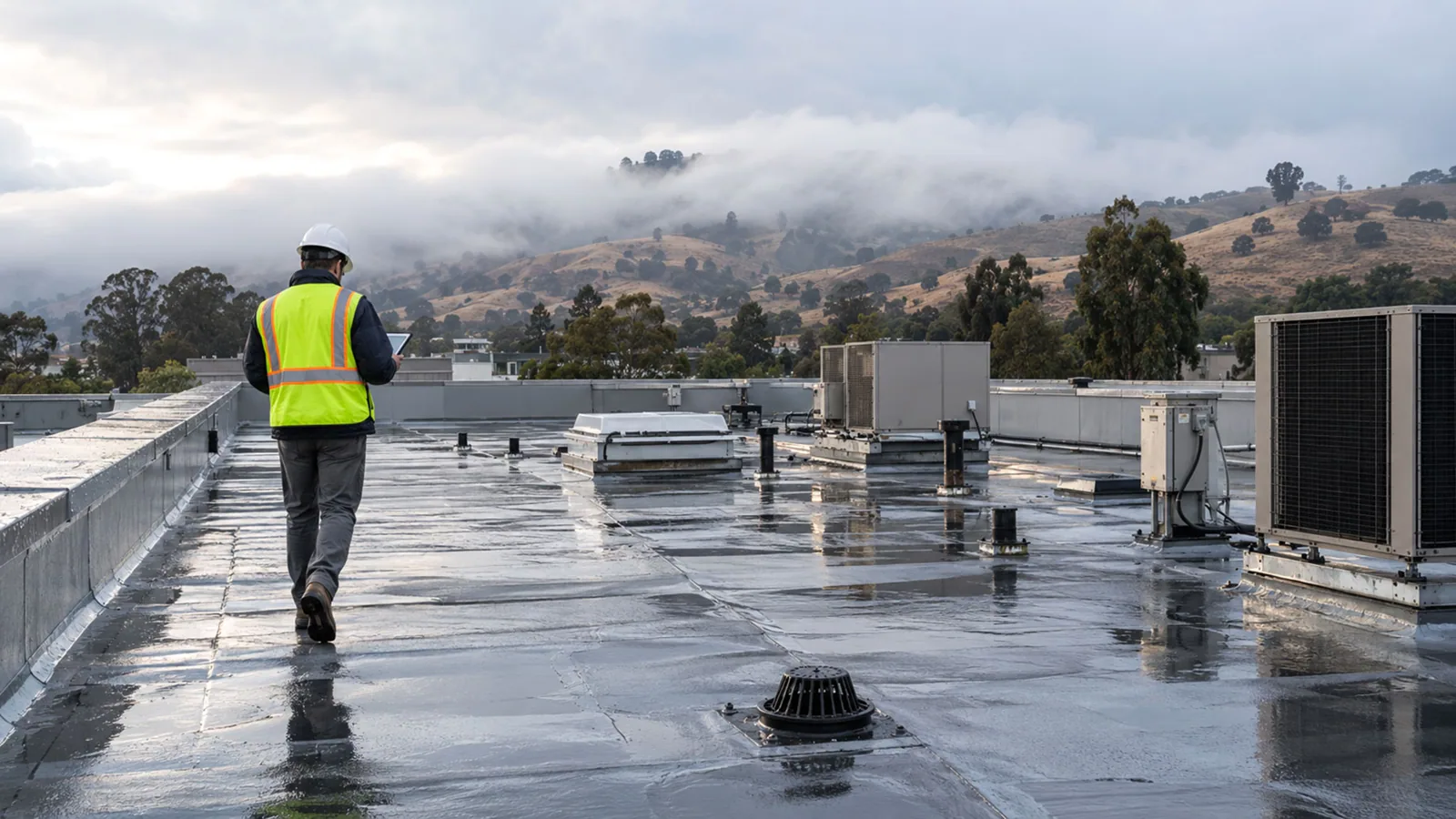
On arrival, the crew checks the access route, the roof edge and the area around the opening. The temporary dry-in is set, photographed and logged with the time and the weather. The facility director receives a short note naming what is covered, what is not and when the next update, with a price or a test recommendation, will arrive. That note keeps emergency work separate from permanent repair, which keeps costs readable.
Route 38 and Woburn Street Areas
The town points to corridor studies for Route 38 and Woburn Street as planning resources for its business areas. The walk establishes the age, size and roof type of each building: membrane type, seam style, insulation layers, penetration count, drainage path. A roof along a busy road also raises access questions, such as where a lift can stand without blocking a customer drive or a neighbor's entrance.
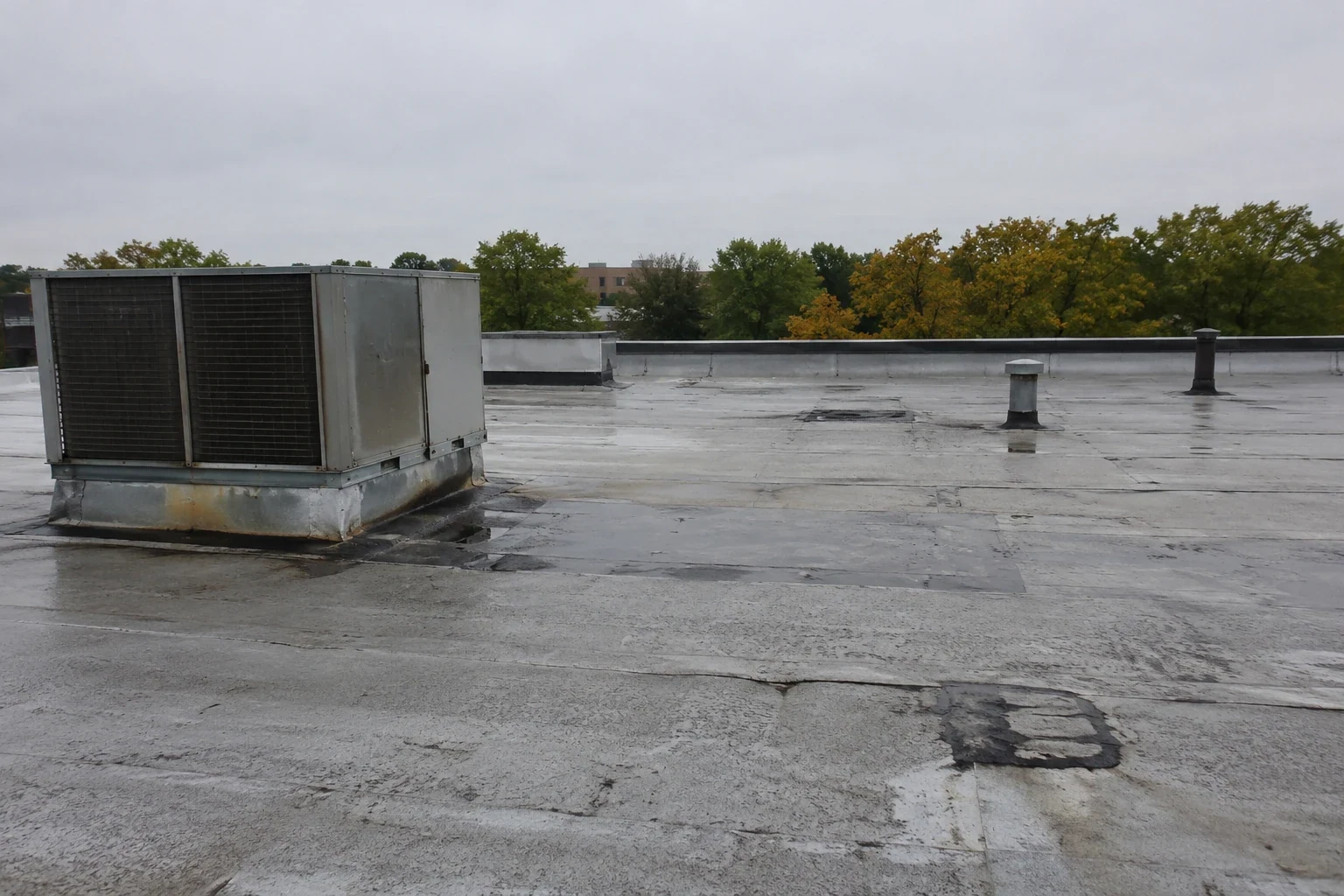
For a retail or service roof, the first inspection looks at edges, drains and the flashing around any rooftop unit. For a roof that shares walls or lot lines with neighbors, the wall flashing is photographed from the owner's side. Where several small roofs are owned by one party, a roof condition report rates each section on the same scale so repairs can be ranked.
Claim Documentation Record
After a storm or a fire, an insurer will ask what was found and when. The record that answers is built in the first hour: dated photographs of each damaged detail with its location marked, interior photographs of the affected area, the weather at the time, the temporary work performed and the materials used. We keep these in one file by roof section.
The roof insurance claim assistance packet adds the repair boundary, the moisture readings and the cost update, so the adjuster sees evidence for both the damage and the proposed scope. Separating emergency work from permanent repair keeps the claim clean: the temporary measures are billed as such, and the permanent scope follows once the roof is dry and the cause is confirmed. A snow and ice damage claim follows the same sequence.
Highway Access for Crews
Direct access to I-93 and I-495 shortens the approach for crews and material. It does not remove the on-site questions: lift position, delivery window, tenant hours and lot control. A site on a corridor with heavy traffic needs a delivery that does not back across a driveway at peak hours. We write the plan before the first truck rolls, and the plan names the entrance, the staging spot and the end-of-day sweep.
For owners who also hold property in Billerica or Lowell, one maintenance calendar can cover all sites, with a separate file per roof. A preventive program sets fall and spring visits, clears drains and logs small repairs.
Drainage and Edge Review
Water that cannot leave a low-slope roof finds the weakest seam. After the first report, the crew checks every drain, scupper and gutter outlet on the affected section, clears debris and records where water stood. Ice in a drain or a scupper throat is noted, and the thaw path is checked. Edges get a hand test: coping, drip edge and termination bars are pushed and pulled to find what moves.
Both checks are cheap compared with the damage they prevent, and both feed the repair list. A loose edge ranks ahead of a cosmetic item because a gust can lift it and widen the damage. A clogged drain ranks high because one more storm adds snow load and water in the same moment. The drain and scupper repair is priced as its own line, so the owner can approve it without approving a larger scope.
Repair Boundary and Scope Decision
The repair boundary follows moisture. A meter pass or an infrared scan finds wet insulation, and a core confirms it. Wet board inside the line comes out. Dry board outside it stays. When the readings spread across sections, the scope decision changes from patch to partial or full replacement, and the note shows the test results behind each figure. A commercial roof repair that holds is the cheapest result; one that repeats is the most expensive, and the record shows which pattern the roof is in.
Commercial Roofing Questions
Does the town's permit review slow an emergency repair?
Not the temporary dry-in. The permit step applies to the permanent replacement scope, and its review time is added to the schedule.
What goes into a claim file after a storm?
Dated photos of each damaged detail with its location marked, interior photos, the weather, the temporary work and the materials used, kept by roof section.
Who rates several small roofs under one owner?
One condition report covers all of them on one scale, so repairs can be ranked by risk and budget year.
What if a lift cannot stand on a busy corridor site?
The delivery plan moves the lift to a side lot or a quiet-hours window, and the cost update states what the change adds.
How do I know when repair stops making sense?
When readings show wet insulation across sections or repairs keep returning to the same spots. The test results and the repair history sit side by side in the scope.