Open the work order, then the doors. A roof report from a government building arrives as a facilities ticket: room, floor, date, and the department that sits below. The first action is the same as anywhere. Keep people away from wet ceilings and live electrical equipment, settle who can reach the roof section overhead, and choose the interior protection. What differs is who must be told. A public counter, a courtroom, a records room, or a council chamber each has its own contact and its own calendar.
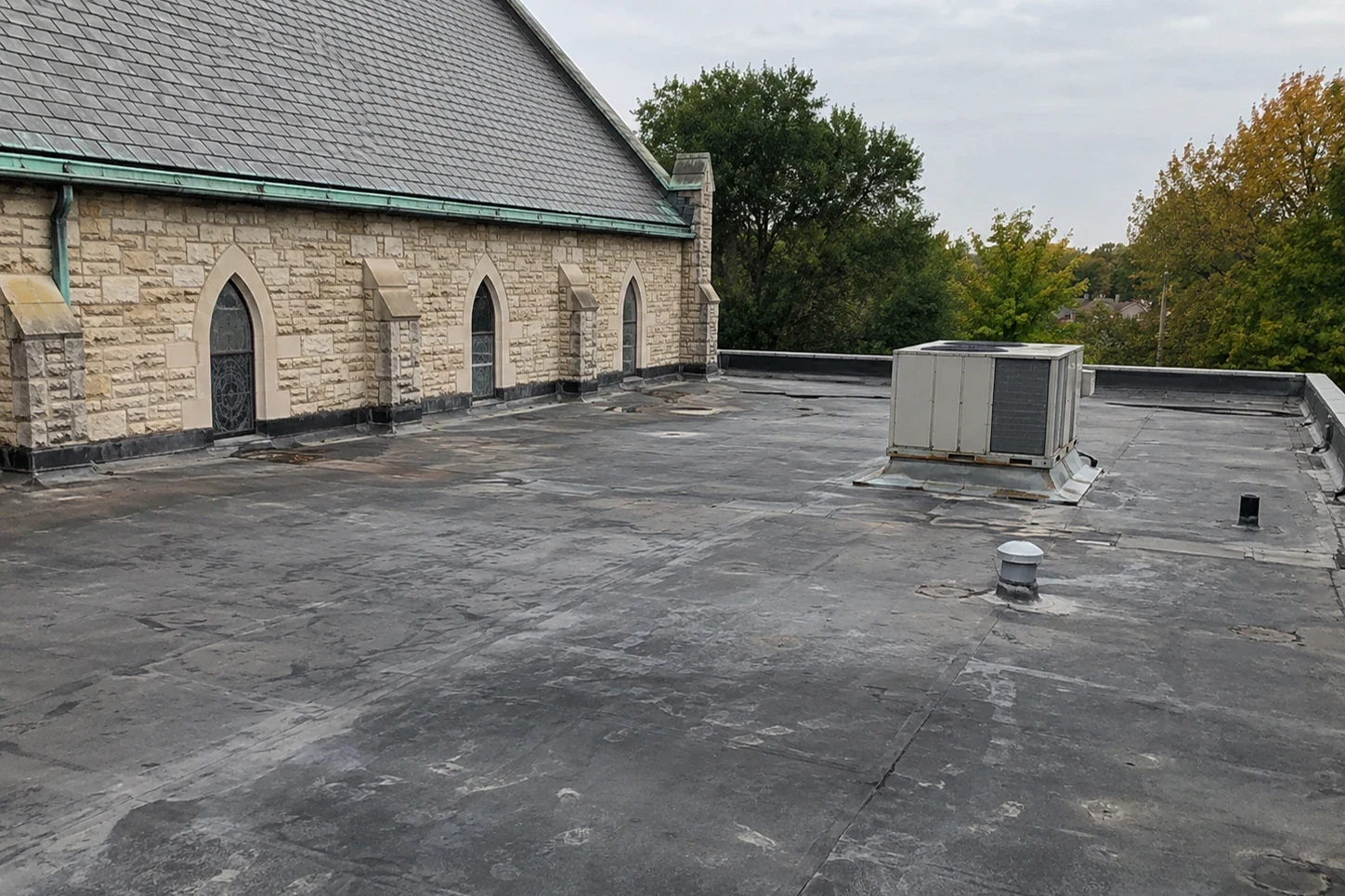
In Lowell, MA, the city's economic profile lists government among its key employment sectors, and public buildings share the climate every other roof sees: rain across the year and winter storms. The facilities director receives the plan in order: first step, repair boundary, and price, each timed, plus a written record that will stand up in a file review.
Public Access and Service Hours
A government building serves people who cannot reschedule: a resident at a permit counter, a witness waiting for a hearing, a clerk filing a deadline document. Roof work above must keep entrances open, walkways clear, and the public away from the work zone. We mark the staging area, set barricades, and agree on delivery times with the facilities contact.
Security rules apply, and they differ from one building to the next. A public health clinic follows entry rules and appointment limits much like those at a medical office roof, while a public works yard or a records office sets its own. Each building sets its own entry rules, and the crew that works on one cannot assume the rules of another. The permit, the escort, and the badge are the first three items on the agenda, and they take days, not hours, when a background check is involved. Material deliveries, lift placement, and the hours when the lot is clear are agreed in writing with the facilities contact before the first truck arrives. Some buildings require sign-in, escort, or screening for contractors. We ask early who issues access, what ID is needed, and whether tools or equipment need inspection at the door. If the building has restricted areas, the plan routes crews around them. These items go into the schedule so the first day does not start with a delay at the front desk. The plan for occupied building reroofing lists noise windows and routes in writing.
Specifications, Records, and Documentation
Public work leaves a paper trail, and the roof file is part of it. Bid documents, specifications, submittals, daily logs, photographs, test results, and closeout papers may all be requested later. We keep our part complete: a roof plan, a numbered photo sequence, moisture and flow test results, the repair boundary as built, and the follow-up date. Where a specification governs, we build to it and flag any condition that would require a change.
Change orders get their own record. If an unexpected condition appears, such as wet insulation past the survey boundary, we photograph it, measure it, and write a scope revision with the cost exposure before work continues. The facilities director can then take a clear document to whoever approves the change. A roof warranty file holds the warranty papers and inspection dates alongside the repair record.
Condition Reports and Capital Budgets
Public budgets run on cycles. A roof that is not ranked this year may not be funded for two. A roof condition report lets a department make its case with evidence: photographs, moisture maps, repair history, and an estimate of remaining service life. A roof capital plan turns the ranking into a multi-year schedule with cost ranges.
We keep the estimates qualitative until a scope is written, since costs depend on moisture, access, and deck condition. The report names the conditions that could not be tested, so the budget includes a contingency for them. Public agencies with many buildings use the same format across the portfolio, which lets the finance office compare needs on one page.
After-Hours Response and Continuity
Some public buildings must keep functioning through a storm, and some can close for a day. The facilities director knows which. We ask for the building's continuity needs when we first visit and write them into the response plan: who calls whom, what interior protection is staged, and where the temporary dry-in material is stored. An emergency roof repair is available around the clock, and the record of the emergency visit feeds the permanent repair scope.
Hurricanes, nor'easters, snowstorms, and ice storms are named among the city's major hazards. That frames our planning for drains, snow access, and weather holds. After a storm, we check edges, drains, and equipment first.
Winter, Drainage, and Roof Access
A record winter of 126.5 inches of snow is on the city's books, and NOAA's Lowell normals put January near 25 degrees. Public buildings with large, low-slope roofs need drains that work all year. We clear and photograph drains, check overflow openings, and measure ponding after melt.
Access in snow takes a decision. If the deck carries drifted snow, or if a lift cannot reach the area, we delay and say so. A weather hold may extend a temporary dry-in. We give the date for the next review and the plan for the dry-in if the hold runs long. Applications filed after July 1, 2025 follow the 10th edition state code, rooted in the 2021 International Building Code, and the local energy rule is confirmed before insulation is specified.
Cost Update and Regional Coverage
Pricing runs in two steps, the same-day temporary dry-in when water is active and the permanent repair after inspection. Each update names the next one. A preventive maintenance program keeps drains clear and seams checked, so fewer leaks reach the emergency column. Each visit adds a dated entry to the file, which gives the department a running history to hand to an auditor, an insurer, or the next facilities director without reconstructing it from memory.
The same method applies to municipal buildings in Lowell and to town and county facilities in Chelmsford, Dracut, and Tewksbury. Public schools follow the plan for school roofing, with student safety added, and public college buildings follow the plan for college and university roofs, where the academic calendar sets the work window. Each update also notes whether a procurement threshold or a board approval is likely to apply, so the facilities director can start that step while the dry-in holds.
Commercial Roofing Questions
Who gets the roof file at closeout?
The facilities director, in the format the department uses. The file holds the plan, photographs, tests, repair boundary, and next review date, and it is complete enough for a records request.
How are unexpected conditions handled on public work?
We photograph and measure them, write a scope revision with the cost exposure, and wait for approval before proceeding. The change record shows why the scope moved.
Can a building stay open to the public during roof work?
Usually. Entrances stay clear, staging stays outside public routes, and noise moves to quiet hours. Restricted areas get a separate plan agreed with security.
What helps a department win funding for a roof?
A condition report with photographs, a moisture map, repair history, and a ranked list. It lets the budget office compare the roof with other needs on facts.
What happens if a storm hits before the permanent repair?
The temporary dry-in is built to the forecast, we state how long it can stand, and the next update carries the date. After the storm we check edges and drains first.